HAROLD
HAROLD is an advanced heterostructure simulator for modeling Fabry-Perot quantum well lasers with near-arbitrary vertical structure and layer compositions. HAROLD also includes a full 3D VCSEL model, taking into account optical, electrical, and thermal effects.
Features
Advanced laser simulations
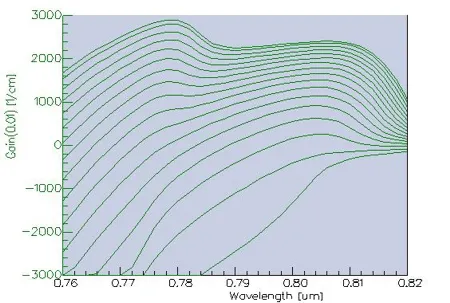
Fabry-Perot cavity modeling in 1D (Y) and 2D (YZ); Pulsed (isothermal) or CW (self-heating) conditions; Harold XY: laser cross-section modeling; Gain curves export for laser / SOA modeling.
Self-consistent solution of Poisson Equation
With drift-diffusion, capture/escape models for electrons and holes.
Full XY or YZ solution of the heat flow equation
Power dissipation: Joule, non-radiative recombination, free carrier absorption, excess power distribution, mirror scattering and mirror absorption; Heat-sink overhang in 2D (YZ) calculations.
2D+Z waveguide mode solver
Used to compute confinement factor and mode gain for TE and TM modes.
Capture/Escape balance equations
Used to describe thermal equilibrium between confined and unconfined carriers in QW regions.
Gain model for QW lasers
Function of wavelength, carrier concentration and temperature; Parabolic band approximation; Can compute both TE and TM mode gain.
Support of multiple QW structures (MQW)
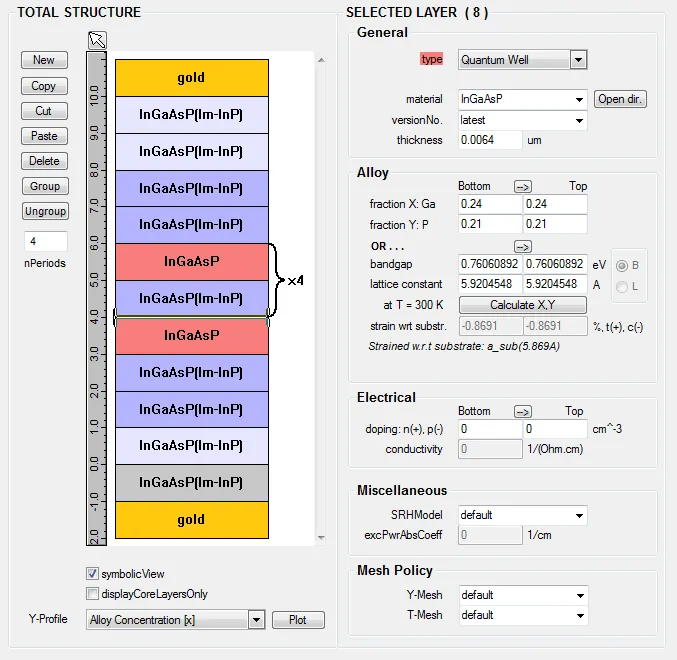
Supports non-identical wells; Schrödinger Equation solved over the whole MQW region to account for coupling between wells; Wavefunction overlaps included in recombination and gain model.
VCSEL
Built-in full-vector 3D cavity mode solver for multiple modes; Built-in far-field calculator; Full 3D thermal heat-flow model; Self-consistent Poisson/drift-diffusion electrical model.
Miscellaneous
Models effect of strain (in QW and barrier layers) on the QW levels; Includes Shockley-Read-Hall, Auger, stimulated & spontaneous recombination; Non-injecting and absorbing mirrors; Material database of quaternary alloys; materials such as AlGaAs, InGaAsP, InGaAlAs, gold, copper, etc.
Applications
- FP Quantum Well lasers
- Ridge waveguide lasers
- SOI hybrid lasers
- VCSELs
- Quantum Dot Lasers
Examples
VCSEL Module
The VCSEL Module allows the calculation of multiple optical cavity modes, electrical drift diffusion, heat flow, and electron-photon interactions in a full 3D model.
Building on Photon Design's decades of experience, the VCSEL module provides a fully integrated design environment for the variety of the VCSEL types being used today, including QW materials, current blocking apertures, and more.
Quantum Dot Module
By employing a 3D strain model and an 8-band k.p model, it is possible to calculate the absorption and gain spectra of laser and SOA quantum dot structures. The QD module enables the design of quantum dot lasers that achieve high-temperature performance using quantum dot materials.
HAROLD's quantum dot model was developed in collaboration with Cardiff University, a leading research center for compound semiconductor photonics in the UK. Excellent agreement was observed between the results of the quantum dot model and experimental data measured at Cardiff University, on devices fabricated by UCL (University College London).
Additional Modules & Connected Products
Extend HAROLD's simulation capabilities with specialized add-on solvers and seamless links to circuit design tools.
Harold XY Laser Module
Enables 2D lateral-vertical (XY) simulations based on a detailed physical description of the laser cross-section, including graded etching, insulating layers, and contact placement for ridge waveguides and hybrid silicon lasers.
Harold VCSEL Module
A comprehensive 3D optical, electrical, and thermal simulation model specifically engineered for multi-mode vertical-cavity lasers.
Harold QCSE Module
Advanced physical model for simulating electro-absorption modulators (EAMs) utilizing the Quantum-Confined Stark Effect (QCSE).
Complex Engine
Allows rigorous simulation of metallic structures and accounts for mode-pulling effects from gain or loss, with Perfectly Matched Layers (PMLs) for leaky mode computation.
Kallistos Multi-Parameter Optimizer
Integrated optimization engine that automatically enhances device geometry and layer thickness to meet target laser thresholds and slope efficiencies.
PICWave Integration
PICWave uses physical gain curves generated by HAROLD within its Wide-Band Gain Model to perform circuit-level simulations of complex PICs and multi-section lasers.
Photon Design Module Map
This module map provides a visual overview of the Photon Design software suite, showing how different tools connect to support your integrated photonics simulations. It starts with the core FIMMPROP module and includes key combinations such as HAROLD and PICWave.
The size of each module indicates its relative role in the design process, while lines represent data flow between components. Together, these tools form a cohesive, interoperable environment for designing and optimizing photonic devices.
Inquire About Software Bundles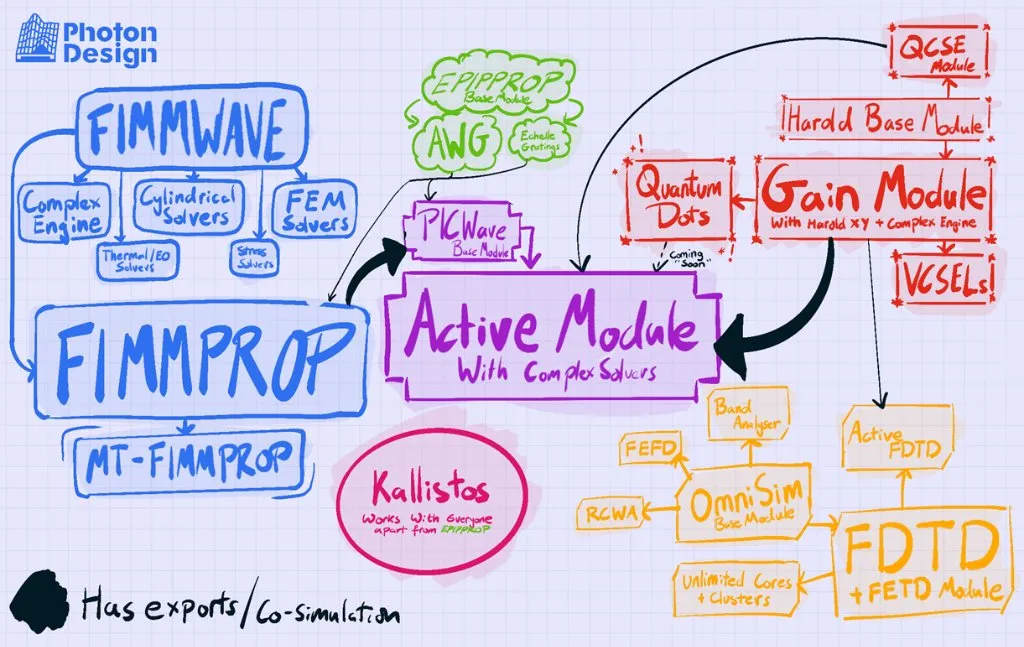
Download the HAROLD Brochure
Discover how HAROLD's advanced heterostructure simulation capabilities empower the design of Fabry-Perot quantum well lasers and 3D VCSELs, with detailed modeling of optical, electrical, and thermal effects.
Quantum Dot Module for Harold
We're excited to announce that in early 2025, Photon Design will introduce a groundbreaking Quantum Dot Module for Harold, expanding our capabilities in simulating absorption and gain spectra for quantum-dot-based lasers and SOAs. This new module incorporates a full 3D strain model, an 8x8 3D k·p band structure calculator, and a multi-level capture-escape model, providing highly accurate results for your quantum dot designs. Developed in collaboration with Cardiff University, this module ensures precise modeling validated against cutting-edge research.
Master HAROLD with Our Video Library
Discover the power of HAROLD with our video guides. Whether you're new or experienced, our videos will help you unlock the full potential of HAROLD features and capabilities.